If you run a food blog with the Recipe Card Blocks plugin, Google Search Console will eventually flag warnings on your recipe pages โ missing fields, invalid values, or items not eligible for rich results. This guide walks through what those messages actually mean, which fields Google requires vs. recommends, and how to fix the issues you’re most likely to see.
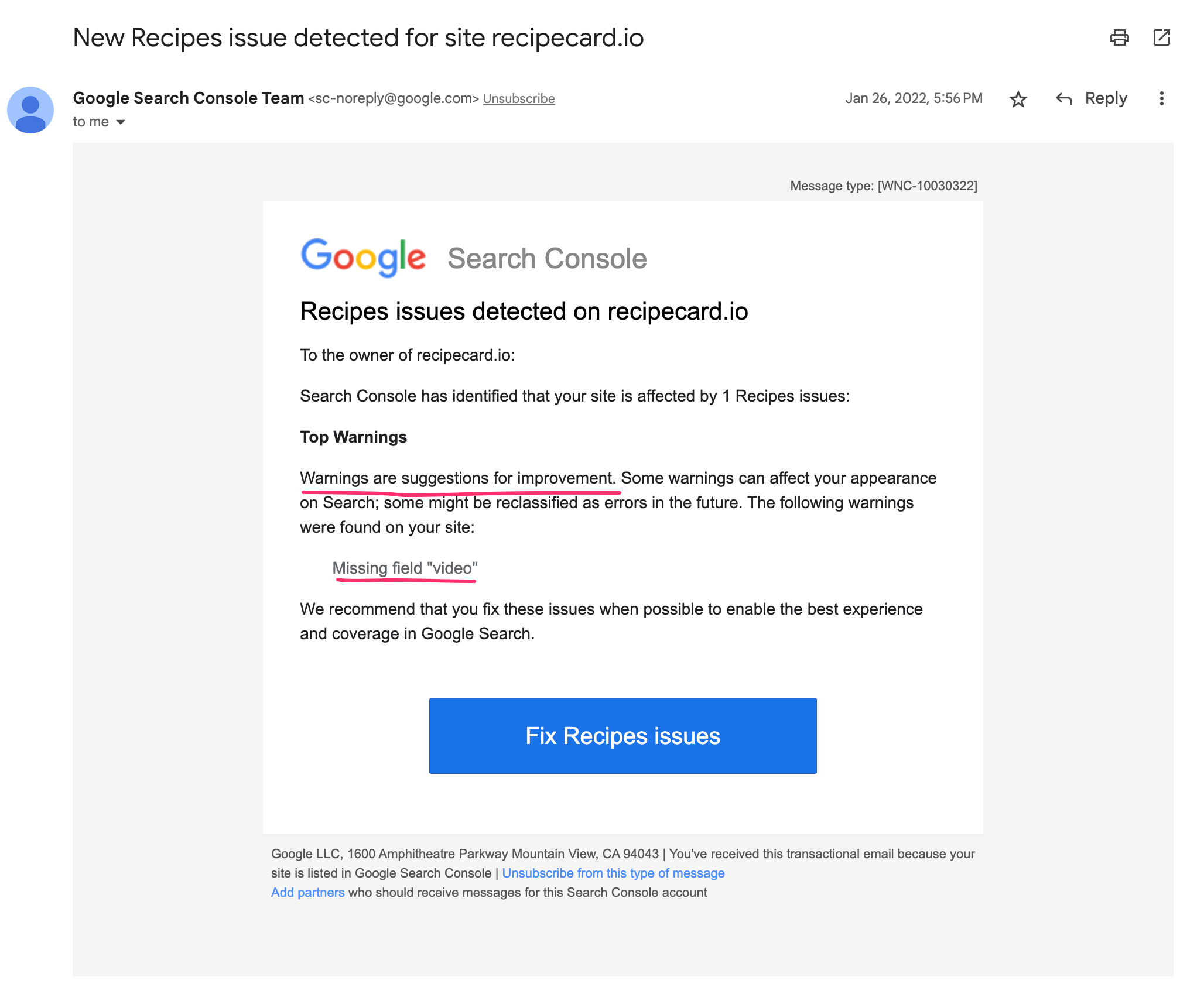
Not every message you receive from Google Search Console indicates a problem. Many messages are simply recommendations for optimizing your site’s performance and visibility on Google Search. Before you spend time fixing something, read the message carefully to identify what type of issue you’re dealing with:
Following Google’s suggestions helps your recipes rank better in search results and attract more visitors. But don’t panic when a Search Console email lands โ most “issues” Google reports are non-blocking.
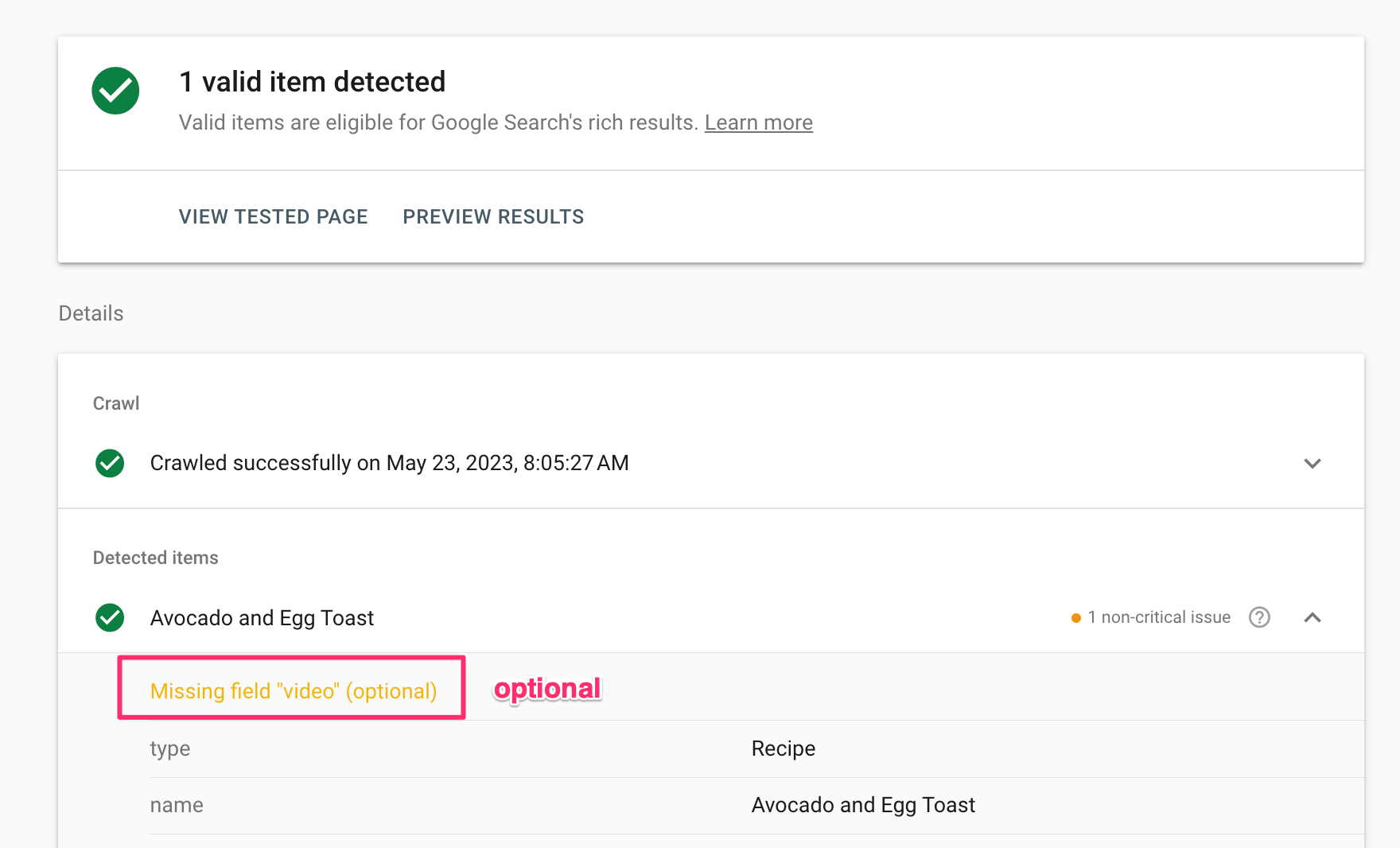
When you run a recipe URL through Google’s Rich Results Test, you’ll see two types of issues flagged.
Critical issues make your recipe ineligible for rich results. Until they’re resolved, your recipe won’t appear with star ratings, cook times, or images in Google Search. These are your priority โ they directly impact visibility and click-through rate.
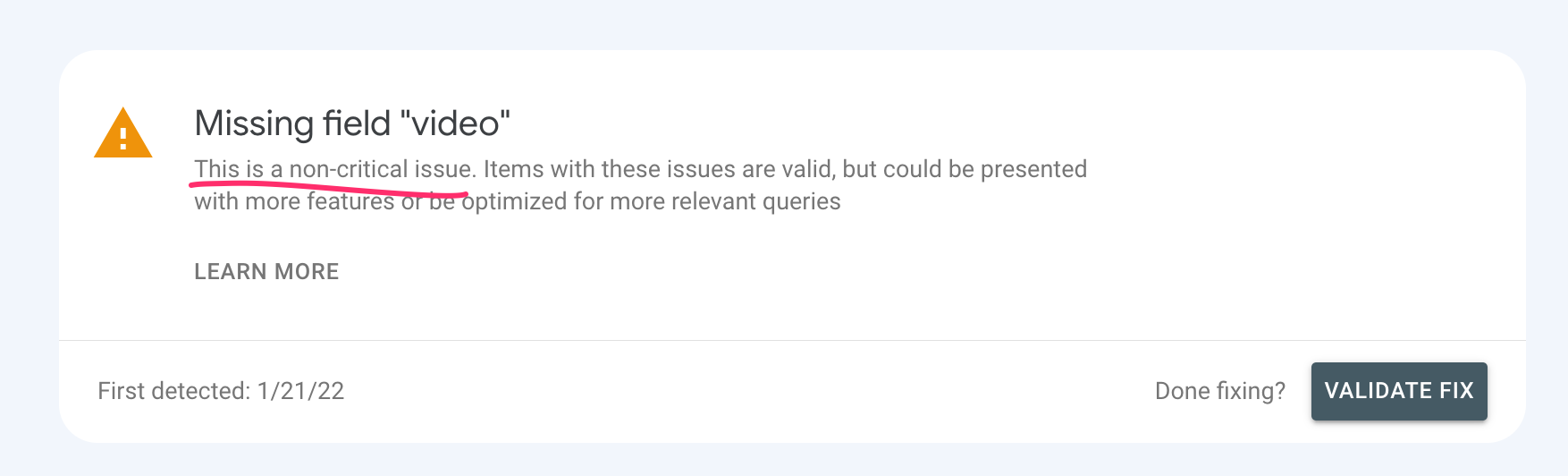
Non-critical issues don’t block rich results. These are recommendations to improve how your content displays and how well it matches user queries. Worth fixing when you have time, since Google occasionally upgrades non-critical fields to required as guidelines evolve.
Google publishes an authoritative list of supported Recipe properties. Here’s the short version of what matters for food bloggers.
Your recipe won’t qualify for rich results without these two fields:
| Field | What it is |
|---|---|
name | The name of the dish |
image | One or more crawlable images of the finished dish |
That’s it. Just two required fields. Everything else is technically optional โ but Google “recommends” a lot more, and missing recommended fields will generate warnings in Search Console.
These trigger warnings in GSC if missing, but rich results still work without them:
| Field | What it is |
|---|---|
aggregateRating | Average review score (drives star ratings in SERPs) |
author | Person or organization who wrote the recipe |
datePublished | Publication date in ISO 8601 format |
description | Short summary of the dish |
prepTime | Prep time in ISO 8601 format (always pair with cookTime) |
cookTime | Cook time in ISO 8601 format (always pair with prepTime) |
totalTime | Total time (or use prepTime + cookTime) |
recipeYield | Number of servings (required if you set nutrition.calories) |
recipeCategory | Meal type โ dinner, dessert, snack |
recipeCuisine | Regional style โ Italian, Mexican, American |
keywords | Other descriptors โ season, holiday, technique |
nutrition.calories | Calories per serving |
recipeIngredient | Each ingredient as a separate entry |
recipeInstructions | Steps to make the dish (HowToStep recommended) |
video | Optional VideoObject |
The Recipe Card Blocks plugin generates all of these automatically when you fill out the corresponding fields in the recipe card editor. The reason you get GSC warnings is almost always because a field was left blank.
When GSC flags an issue, follow this workflow:
Go to search.google.com/test/rich-results and paste your recipe URL. The tool tells you exactly which fields are missing or invalid and whether the issues are critical.
validator.schema.org catches schema.org-level issues that the Rich Results Test sometimes misses โ incorrect property types, nesting errors, or malformed values.
In Search Console, paste your URL into the search bar at the top. Click Test live URL and expand the Enhancements > Recipes section to see the structured data Google sees right now โ which can differ from what’s actually on your page if caching or a plugin is interfering.
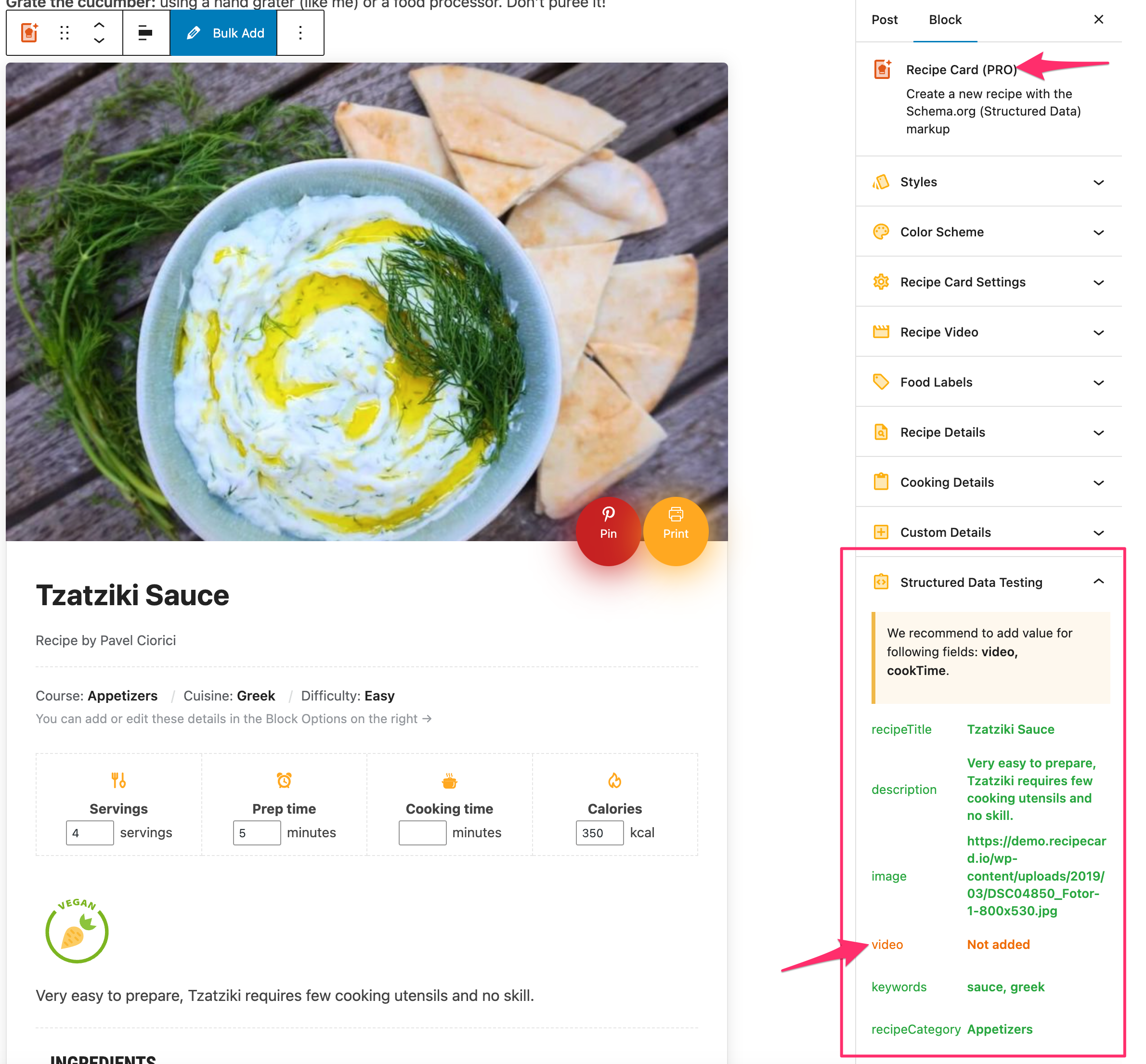
Open the post, scroll to the Recipe Card block, and fill in any missing fields the tools flagged. The plugin’s built-in Structured Data Validator will confirm each field as you complete it.
After saving, re-run the Rich Results Test on the live URL. If it passes, go back to URL Inspection in GSC and click Request indexing. Google typically re-processes within a few days.
Recipe Card Blocks includes a built-in Structured Data Validator that runs as you edit a recipe. The sidebar flags any missing schema.org fields in real time, so you can fix issues before publishing instead of waiting for Google to discover them weeks later.
This is the fastest way to prevent GSC warnings in the first place. If the validator shows a green checkmark before you hit publish, you should not see warnings for that recipe in Search Console later.
The most common critical issue. Without an image, your recipe is ineligible for rich results.
What Google wants:
robots.txt or noindex)Open the recipe block, click the image area, and upload a featured photo of the finished dish. The plugin handles the schema output automatically. If the image is already there and you’re still getting warnings, check that your media URL isn’t blocked in robots.txt and that no SEO plugin is adding noindex to your uploads directory.
You’ll see this on every recipe that hasn’t been rated yet. Without ratings, your recipe won’t show star icons in search results โ which is one of the biggest click-through drivers for food content.
Enable recipe ratings in the plugin settings (documentation). Once readers start leaving ratings, the aggregateRating field populates automatically. We strongly recommend also enabling ratings in comments โ this significantly increases how many readers actually rate the recipe.
If you have an old recipe with no ratings and want to seed it, the rating must come from a real reader. Faking ratings violates Google’s structured data guidelines and can trigger a manual action against your site.
A common warning. Not blocking, but adding nutrition info can affect how your recipe appears in rich results and is increasingly surfaced by Google.
Open the recipe block, scroll to the Nutrition Facts section, and fill in calories at minimum. The plugin pairs nicely with the Recipe Nutrition Analyzer โ paste your ingredients and it calculates the values for you.
Note: if you specify nutrition.calories, Google requires you to also specify recipeYield (servings). The plugin handles this automatically, but it’s worth knowing if you’re debugging.
All three are recommended. You can use totalTime alone, or specify prepTime and cookTime separately (the plugin sums them into a total automatically).
Fill in the prep time and cook time fields in the recipe block. If you’ve already filled them in and still see a warning, the issue is usually that one of them is zero or blank.
Common bug: ISO 8601 format errors. The plugin outputs PT15M for 15 minutes, PT1H30M for 1 hour 30 minutes. If you’re seeing format-related errors, you may have an old recipe imported from another plugin with a malformed value. Edit the recipe and re-save to regenerate the schema.
Required if you have nutrition info, recommended otherwise.
Set the servings field in the recipe block. Use a plain number (“6”) or a phrase (“4 sandwiches” or “24 cookies”). The plugin also supports adjustable servings for readers, which uses the same value.
Three separate but related warnings. All recommended, none critical.
Per Google’s guidelines, keywords should not duplicate category or cuisine values. Use them for things like season, technique, or audience โ “weeknight”, “kid-friendly”, “vegan”.
You’ll see this if your recipe doesn’t have an author assigned (uncommon, but happens with imported content or when a user account is deleted).
Check the post’s author in WordPress. If it’s set correctly, the plugin will output author.name automatically. For sites that use a brand name as author, set the author to your organization โ Google accepts both Person and Organization types.
WordPress sets this automatically when you publish a post. If you’re seeing this warning, the post is probably still a draft, scheduled, or has a corrupted publish date.
Check the post’s publish date in the editor sidebar. Save and re-publish if needed.
The non-critical warning that frustrates most food bloggers. Google flags it on every recipe without a video, even though video is entirely optional. This is a non-critical issue โ it’s a recommendation, not an error.
Less common, but appears on imported recipes or recipes built before HowToStep became the recommended format.
Re-save the recipe in the block editor. The plugin will regenerate the instructions using the current HowToStep format. If the error persists, check that no instruction step contains only a heading like “Step 1.” โ Google’s documentation explicitly recommends against including step numbers or “Directions:” prefixes inside the instruction text itself.
Rare, but appears when a recipe’s author has been corrupted in the database or when a third-party plugin is overriding author output.
Open the post, reassign the author in the sidebar, and update. If the issue persists across all your recipes, your theme or another plugin may be overriding the author output โ check for theme template overrides or SEO plugins modifying schema output.
Two important context updates many food bloggers haven’t caught:
FAQ rich results: In August 2023, Google restricted FAQ rich results to “well-known authoritative government and health websites.” If you used to see FAQ snippets on your recipe posts and they disappeared, this is why. The schema itself is still valid โ it just no longer triggers rich results for food sites.
HowTo schema: Google deprecated HowTo rich results entirely in 2023. However, this does not affect Recipe schema. HowToStep inside recipeInstructions is still the recommended format. The deprecation applies only to standalone HowTo pages โ recipes are unaffected.
This is the most common follow-up issue food bloggers ask about after fixing schema warnings โ and it’s not a schema problem. Google has crawled the page but chosen not to index it.
For recipe content, the usual causes are:
Add genuine editorial context to your recipes โ backstory, technique notes, ingredient substitutions, troubleshooting tips. Google’s Helpful Content guidelines reward original, expert content over thin recipe-only posts. The schema is necessary but not sufficient โ indexing decisions are based on overall content quality.
If you use AMP, schema validation runs separately for the AMP version of each page. A recipe that passes the Rich Results Test on the regular URL can still fail on the AMP version if the AMP plugin strips or modifies elements.
Recipe Card Blocks PRO includes AMP compatibility โ see the AMP documentation for setup. After enabling, validate your AMP recipe URL separately in the Rich Results Test by appending ?amp to the URL (or whatever your AMP slug is).
The pattern across nearly every GSC warning is the same: a field is missing or blank in your recipe card. The Recipe Card Blocks built-in validator is the single most effective way to prevent these issues โ fix them before publishing, not three months later when Google emails you.
For ongoing maintenance:
If you’re stuck on a specific warning, our support team can help diagnose the issue.